High-Rise Medical Emergency: The Gap Between Arrival and Your Door
The clock that matters in a high-rise medical emergency does not stop when the ambulance arrives. It stops when the crew reaches the patient — and in a tall building, those are two very different moments. Research in a major North American city measured a median of 2.73 minutes between the ambulance stopping and paramedics reaching a patient three or more floors up, compared with 1.25 minutes at or near ground level. For calls from three or more stories above ground, that access period accounted for roughly 32% of the entire response time (Morrison et al., 2005).
That gap is largely a logistics problem. Logistics problems can be worked on in advance, by ordinary residents, at no cost — which is why this is worth reading before a power cut rather than during one.
What happens during a high-rise medical emergency before the knock on your door
The vehicle pulls up. The crew gathers equipment, which in a cardiac or trauma call can mean a monitor, a bag and an oxygen cylinder carried between two people. They reach a secured entrance. They find the right core, the right floor, the right number along an unlit corridor (hallway).
Each of those steps is short. Together, in the study above, they consumed nearly a third of the response interval for calls from upper floors — and that was with elevators (lifts) working normally.
The clinical consequence has been measured too. A study of 7,842 out-of-hospital cardiac arrests in Toronto and the surrounding region found survival to hospital discharge of 4.2% for patients below the third floor, 2.6% at the third floor or above, and 0.9% above the sixteenth floor. Of the 30 arrests recorded above the twenty-fifth floor, no survivors were reported. Time from first responder arrival on scene to patient contact was 4.9 minutes on the third floor or higher, against 3.0 minutes below it (Drennan et al., 2016).
Two caveats belong with those numbers. They describe cardiac arrest, the single most time-critical emergency there is, and they should not be read across to every call. And the access study was an observational review of 118 emergency calls over a two-week period, now two decades old — a small sample, though its findings concern building design and signage, which have changed little since.
Read honestly, the evidence supports a narrow and useful claim: in a tall building, a measurable part of the delay happens after help has already arrived, and some of it sits within a household's influence.
Why carrying the patient down is usually the wrong instinct
The impulse to meet the crew halfway is a generous one, and in a stairwell it rarely helps.
A working elevator (lift) does not mean a stretcher (trolley) ride
The same observational study recorded that in apartment (flat) calls, the stretcher (trolley) did not fit in the elevator 67.9% of the time. A stair chair was needed in 15.6% of cases, and the elevator was unavailable altogether in 12.1%. Extraction from an upper floor is a planned, equipment-dependent maneuver even on an ordinary day — which is part of why crews arrive prepared to work where the patient is.
Movement costs more than time
Moving an unwell person down concrete stairs in poor light increases the risk of falls, interrupts ongoing care, and separates the patient from where the crew expects to find them. If a household begins a descent while the crew begins a climb, they can pass on different staircases in the same building.
The practical default is therefore to stay with the patient, keep the line to the call handler open, and let the arriving crew make the extraction decision. That decision is theirs, and they make it with equipment and training a household does not have.
The exception is an immediate environmental hazard — fire, smoke, or a suspected gas leak. In that situation, the building's own fire strategy governs, and the ambulance service should be told what is happening as it changes. Fire doors are part of that strategy: they are never wedged or propped open to make a route easier, because the compartmentalization they provide is what keeps a stairwell usable — one of several apartment safety decisions that change during a blackout.
Four things that help a crew reach you sooner
None of these require equipment, training, or spending money. A household can decide on all of them now.
1. Give the access details on the call, not at the door
Ambulance services ask for this information directly. Official dispatch protocols from emergency services and the UK NHS (South Western Ambulance Service Foundation Trust) advise callers that the service needs to know "if there are any difficulties in accessing the patient or the property," asking specifically whether "door codes [are] required" and whether the "address [is] particularly difficult to find." It also asks where in the property the patient is located, and advises putting pets into a separate room so they do not interrupt care.
So: the building number and the apartment number, the entry code, which core or staircase, which floor, and which side of the corridor. In the access study, an entry code was required on 67.6% of the apartment calls where it applied. That code is worth saying out loud early, before anyone is on the stairs.
2. Send someone to the entrance
One person at the street door with a flashlight (torch) helps mitigate the secured-entry problem and guides the crew for the rest of the route. If the household has only one adult present, the call handler should be told that nobody can come down — crews plan differently when they know they are arriving to a closed door.
3. Mark the route
In the access study, directional signs were not provided in 82.6% of apartment building calls. In a blackout, with no lift indicator and no corridor lighting, an unmarked door on an unmarked floor is genuinely hard to find.
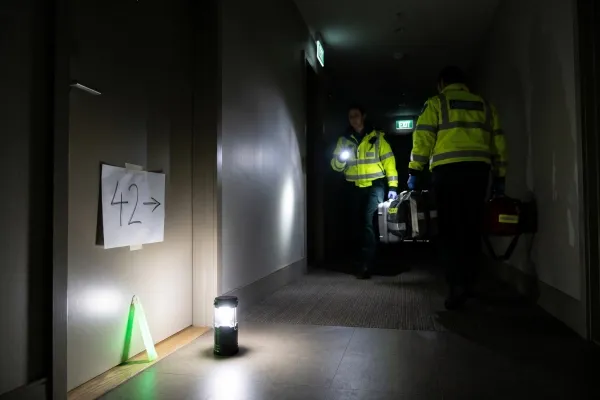
A sheet of paper taped at the entrance with the floor and apartment number and an arrow, and a second one at the lift lobby, costs nothing and lasts indefinitely. A battery light or glow stick left at the apartment door marks the destination without anyone standing in the corridor to point.
4. Alert the building, and hold the elevator down
Where a building has staff on site, telling them an ambulance is coming lets them do two things that measurably help: bring the elevator to the ground floor and hold it, and escort the crew up. New York City's housing agency specifically advises training building staff to assist emergency responders, "including by recalling or holding an elevator, advising responders, and escorting them to residents who need help" (NYC Department of Housing Preservation and Development, n.d.). The Toronto researchers recommended the same from the clinical side, along with giving paramedics universal elevator access keys (Drennan et al., 2016).
What to put in place before the power goes out
Register a medical need in advance
In the United Kingdom, the Priority Services Register is a free scheme that lets gas, water and electricity suppliers identify customers who may need additional support during an outage. The Cabinet Office's Be Ready campaign names signing up to it as a first step, alongside keeping a small supply of non-perishable food and water and preparing for roughly three days of disruption (Cabinet Office, 2026). Three days of water for one household is heavier than most people expect, and in a flat the weight has to go somewhere.
Federal health protocols from the US CDC, paralleled by guidance from the UK National Resilience Directorate, advise households that depend on mains electricity for medical equipment to build a power plan that records each device's model and serial number, to confirm with the manufacturer whether a device will run on batteries or a generator, and to keep a non-electric fallback where one exists — a manual wheelchair alongside a powered one, for instance (Centers for Disease Control and Prevention, n.d.). Telling building management about a lift-dependent or equipment-dependent household belongs on the same list, since staff can only check on residents they know about.
Keep a one-page medical summary where it can be handed over
A single sheet listing current medications and doses, known allergies, significant conditions, the name of a regular doctor (GP) and an emergency contact lets a crew work from written information instead of recollection at a difficult moment. Kept somewhere consistent and obvious — inside a kitchen cupboard door, on the refrigerator — it survives the fact that whoever knows the answers may be the person who is unwell.
Light the route, not just the room
Most households own at least one flashlight (torch). Few have thought about where the light needs to be. A high-rise emergency has three lit positions that matter: the street entrance, the stairwell or lift lobby, and the apartment door. Battery lanterns or glow sticks at those three points help navigate an otherwise dark building into a marked, accessible one.
The short version
Navigating a high-rise medical emergency with an elevator out of service requires proactive coordination. If someone in a tall building requires urgent medical support:
Call the emergency number — 911 in the United States and Canada, 999 in the United Kingdom, 112 across the European Union and much of the rest of the world.
Provide the entry code, core, floor, and apartment number early, and state plainly that the lift isn't working.
Stay with the patient and keep the line open. Let the crew decide whether and how to move anyone.
Send one person down to the entrance with a light, if anyone can go.
Tell building staff, and ask them to hold a working elevator at ground level.
It is reasonable to find this prospect frightening. The honest response to that feeling is not to set it aside but to spend twenty minutes on the parts that can be settled in advance — the sign, the light, the code written down, the medical sheet on the cupboard door. Those are small, and the evidence suggests they support household autonomy and help mitigate the part of the delay residents can actively manage.
Continue reading
A fuller account of urban emergency response — recognizing the time-critical presentations, understanding what ambulance crews need from bystanders, and navigating the specific problems of tall buildings — is available in The Civilian First Responder: Practical Care for the Hours Before Help Arrives by Rowan Halsey.
This article is general information about emergency logistics and preparedness. It is not medical advice and does not replace assessment by a qualified clinician or the instructions of an emergency call handler. In a medical emergency, contact your local emergency number and follow the guidance you are given. Readers seeking practical skills are encouraged to complete an accredited first aid course delivered by a recognized provider.