Apartment Water Storage | Floor Limits
Official guidance on emergency water is consistent and easy to find. The US Centers for Disease Control and Prevention (CDC) and the UK National Resilience Directorate advise maintaining an emergency water supply at an apartment threshold of at least one gallon (3.8 liters) per person per day for three days, and a two-week supply where possible to support household autonomy (Centers for Disease Control and Prevention, 2024). When calculating how much water to store for emergencies, it is vital to recognize that a two-week supply for a family of four weighs roughly 467 lb (212 kg). The residential baseline floor load capacity for a typical apartment (flat) is commonly specified as 40 lb per square foot.
Those two numbers are not in conflict. A household can hold that much water on an upper floor without difficulty. But the arrangement matters a great deal, and the common instinct — one large drum, in a cupboard, in the corner — is the one arrangement that does not work. This article sets out the arithmetic so the decision can be made on numbers rather than impression.
A correction worth making first
Published preparedness material frequently states water weight in mixed units, and the error is easy to miss. A US gallon and an Imperial gallon are not the same volume: 30 US gallons is 114 liters and weighs 250 lb (113 kg), while 30 Imperial gallons is 136 liters and weighs 301 lb (136 kg). A reader in the United Kingdom applying a US figure, or the reverse, will be off by about 20%.
Throughout this article, "gallon" means a US gallon, and liter and kilogram equivalents are given alongside. Water weighs 8.345 lb per US gallon, and 1 liter weighs 1 kg — the metric figure being the easier of the two to work with.
What the guidance actually asks you to store
Household | Duration | US gallons | Litres | Weight (lb) | Weight (kg) |
|---|---|---|---|---|---|
1 person | 3 days | 3 | 11 | 25 | 11 |
1 person | 2 weeks | 14 | 53 | 117 | 53 |
2 people | 3 days | 6 | 23 | 50 | 23 |
2 people | 2 weeks | 28 | 106 | 234 | 106 |
4 people | 3 days | 12 | 45 | 100 | 45 |
4 people | 2 weeks | 56 | 212 | 467 | 212 |
The one-gallon-per-person-per-day figure covers drinking and basic food preparation. It does not cover washing. For context on full domestic needs, the Sphere Handbook — the international standard used in humanitarian response — puts basic water needs at 7.5 to 15 liters per person per day across drinking, cooking and personal hygiene, and sets 15 liters as its minimum indicator (Sphere Association, 2018). Storing to that standard for two weeks would mean over 800 liters for a family of four, which no apartment should attempt. Beyond a few days, hygiene water comes from refilling, not from storage.
What the floor was designed to carry
Residential floors are specified as a uniformly distributed live load — a weight per unit of area, assumed spread evenly.
In the United States, the governing figures come from ASCE 7, reproduced in the International Building Code. Residential living areas are designed for 40 lb per square foot (1.92 kN/m², or 195 kg/m²). Sleeping rooms in one- and two-family dwellings are designed for 30 psf (1.44 kN/m², 146 kg/m²). Private rooms in hotels and multifamily buildings, and the corridors serving them, are 40 psf (US Department of Housing and Urban Development, 2000).
In the United Kingdom and across the EU, BS EN 1991-1-1 and its UK National Annex place rooms, kitchens, stairs and landings in dwellings in Category A at 1.5 kN/m² (31 psf, 153 kg/m²), with a separate concentrated load check of 2.0 kN applied over a 50 mm by 50 mm area.
Two things follow from how these numbers are written.
First, they are conservative relative to ordinary life. The HUD guidance notes that the sustained component of residential live load — furniture, occupants, possessions — averages roughly 6 psf, with a transient component of a similar size that occasionally reaches about 13 psf. A 40 psf design value against a typical actual load of 12 psf is a substantial margin, and structural codes then apply further load factors on top. This is why floors feel immovable underfoot, and it is the reason this article is about arrangement rather than alarm.
Second, that margin is an area average. It is not a license for any single point. The Eurocode includes a separate concentrated load check precisely because a small, dense load can govern local strength even when the room average is comfortable.
Why one large container is the wrong answer
A 55-gallon drum is the default image of water storage, and in an apartment it is the one container to avoid.
Filled, it holds 459 lb of water; with the drum itself, call it 479 lb (217 kg). A standard drum is about 22.5 inches across, giving a footprint of 2.76 square feet. The resulting bearing pressure is:
479 lb ÷ 2.76 sq ft = 173 psf (8.3 kN/m²)
That is 4.3 times the 40 psf design live load, concentrated on a single circle of floor. Whether a particular floor would carry it depends on its construction, its span, and where in the room it sits — questions a resident cannot answer from inside the apartment. The point is not that the floor would fail. The resident has no way to know and is accepting an unquantified risk for no benefit, because the same water, in a different arrangement, is comfortably within the design basis.
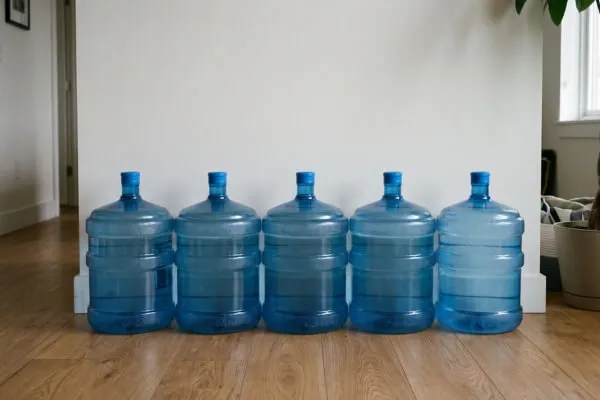
Take the same 55 gallons in eleven 5-gallon jugs, set in a single row along a wall. Each jug weighs about 43 lb. Across their own footprints the pressure is 51 psf; spread along a 2 ft by 7 ft strip of floor, it is 34 psf — below the 40 psf the floor was specified for.
Same water. Same room. One arrangement sits at 173 psf, the other at 34.
Where the weight should go
Spread, in a single layer
Stacking concentrates load in exactly the way the arithmetic above warns against, and it introduces a second problem: a stacked column of water containers is unstable, and the lower containers carry a compressive load they were not designed for. One layer, in a row, is the arrangement to aim for.
Near a support, not in the middle of the span
For a floor spanning between supports, bending and deflection are greatest at mid-span and least near the supporting walls. The same weight placed against a supporting wall produces a smaller structural demand than it would in the center of a room.
The honest difficulty is that residents often cannot tell which walls are load-bearing. Exterior walls generally are; interior partitions often are not. Where it matters, building management, the managing agent, or the original drawings will know, and asking costs nothing.
Construction type also changes the picture. A modern concrete-framed tower has floor slabs with considerably more reserve capacity than the timber-joist floor of a low-rise or converted building, where the span between joists and the condition of the timber both matter. A resident who does not know which they live in should assume the more cautious case.
Not on a balcony
Balconies are designed to different loadings from interior floors and, where cantilevered, concentrate load at the point of attachment. They are also exposed to temperature extremes that stress containers. A balcony is not a storage solution, and in many buildings the lease restricts what may be placed there.
The reservoir the apartment already has
A bathtub (bath) holds 40 to 50 gallons, which at roughly 334 to 417 lb over 13 to 15 square feet works out to 26 to 28 psf—within the design basis—and over a floor area already built to carry a filled tub and a person in it.
This is a short-notice measure rather than long-term apartment water storage: water drawn at the start of an infrastructure disruption, used for flushing and washing rather than drinking, recognizing that most bathtubs (baths) lose water slowly. Purpose-made bathtub liner bladders address both hygiene and leakage and store flat when not in use.
Keeping stored water usable
The CDC's guidance on containers and conditions is specific, and most of it costs nothing to follow (Centers for Disease Control and Prevention, 2024):
Use food-grade containers. Never reuse a container that held a toxic substance such as bleach or pesticide.
Clean and sanitize before filling: wash with soap, then sanitize with one teaspoon of unscented household bleach (5–9% sodium hypochlorite) per quart of water, shake, wait at least 30 seconds, empty and air-dry.
Store between 50°F and 70°F (10–21°C), out of direct sunlight, and away from petrol, pesticides and similar substances — some plastics admit vapors over time.
Label every container "drinking water" with the date filled, and replace stored tap water every six months. Observe the printed date on commercially bottled water.
Draw water out with a clean scoop rather than by hand.
One addition from physics rather than guidance: water expands by roughly 9% on freezing. Containers stored anywhere that may drop below freezing — an unheated garage, a balcony store, against an uninsulated exterior wall in a cold climate — need headspace left in them, or they will split.
For households where someone depends on mains electricity for medical equipment, water storage sits alongside a broader set of preparations, and building management knowing in advance that the household exists is part of it — a point that matters when an ambulance has to reach an upper floor.
When to stop doing arithmetic and ask someone
This article provides figures for planning. It is not a structural assessment of any particular building, and it cannot be.
Professional advice is warranted where the quantity is substantial, where the building is older or of unknown construction, where the intended location is a converted loft or an upper story of a timber-framed building, or where there is any existing sign of floor movement — sloping, springiness, cracking in ceilings below. A structural engineer can answer in an hour what no amount of arithmetic will settle from inside the room.
Two other checks belong on the same list. Leases and building rules frequently restrict storage in communal areas, on balconies, and in service cupboards. And buildings with a managing agent generally expect to be told about anything substantial being brought in.
For the wider question of which household decisions change when the power and water go off in a tall building, see the apartment-specific safety considerations in an extended outage.
The short version
Water weighs 8.345 lb per US gallon; 1 liter weighs 1 kg. Specify which gallon.
A two-week supply for four people is 56 US gallons — 212 liters, 467 lb, 212 kg.
Residential floors are designed for 40 psf in the US (1.92 kN/m²) and 1.5 kN/m² in the UK and EU — as an area average, not a point load.
A filled 55-gallon drum applies about 173 psf. The same water in jugs along a wall applies about 34 psf.
One layer, in a row, against a supporting wall. Not stacked, not mid-room, not on a balcony.
Food-grade containers, labeled and dated, 50–70°F, out of sunlight, rotated every six months.
Anything substantial, any older or unfamiliar building, any sign of floor movement: ask a structural engineer and check the lease.
The weight question is worth taking seriously, and it resolves into something quite ordinary: not less water, just water laid out differently. Most households find the arrangement is the only thing they need to change.
Continue reading
Water is one element of a broader approach to maintaining household autonomy during urban infrastructure disruption — alongside power, heating, sanitation and food security in buildings not designed to function without services. Rowan Halsey covers these in detail in The Grid-Down Apartment Survival Guide.
Disclosure: This site earns from qualifying purchases.
This article is general information about load arithmetic and emergency water storage. It is not a structural engineering assessment of any specific building, and it does not replace advice from a qualified structural engineer, your building management, or the terms of your lease. Readers planning substantial storage, or storage in a building of older or unknown construction, are encouraged to obtain a professional assessment before proceeding.