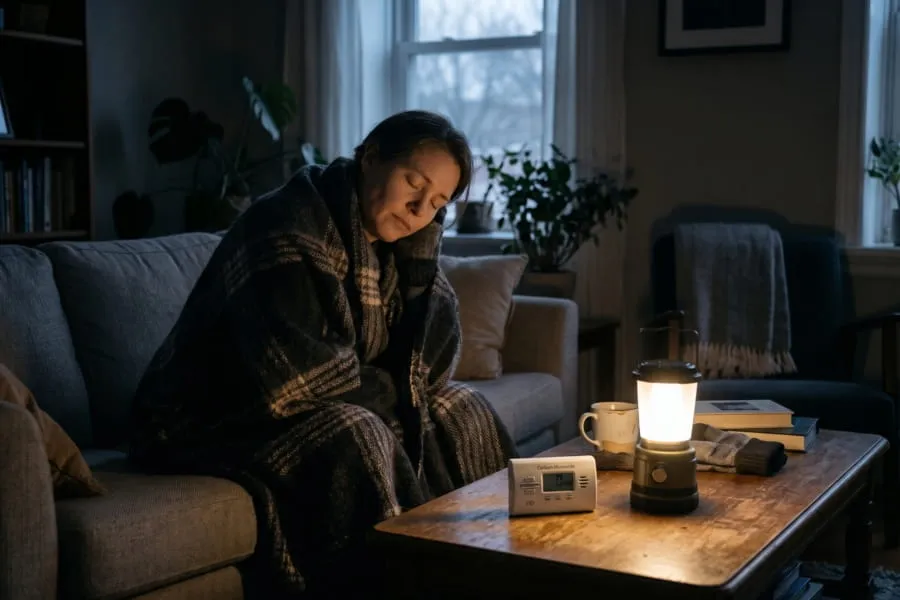
Carbon Monoxide Symptoms And Blackout Risks
Headache. Nausea. Weakness. Trouble concentrating. Irritability that is out of character. A household three days into a power cut (power outage) — cold, sleeping badly, eating oddly, managing children whose routine has collapsed — has every reason to attribute all of it to the obvious cause.
That is the central difficulty with carbon monoxide. It is colorless and odorless, and its early presentation is indistinguishable from the stress reaction a disrupted household already expects. The CDC and NHS describe early carbon monoxide symptoms as "flu-like" (Centers for Disease Control and Prevention, 2024). A caregiver who has spent two days attributing headaches to the situation is primed, by entirely reasonable logic, to attribute one more.
And the device many households now own — a fingertip pulse oximeter, bought during the pandemic and sitting in a drawer — cannot settle the question. It can read a reassuring 98% on someone who is severely poisoned.
Why an outage is when this matters most
Carbon monoxide is produced by anything that burns. Risk rises during a power cut not because the hazard changes, but because households introduce combustion indoors that was not there the week before.
The CDC's prohibitions on this are specific and absolute:
Operate a generator outdoors only, more than 20 feet from windows, doors, and vents. Never inside a home or garage, even with the doors and windows open.
Never burn charcoal indoors — charcoal of any color gives off CO.
Never use a portable gas camp stove indoors.
Never heat a home with a gas oven, and never burn anything unvented on a stove or in a fireplace.
Never run a car or truck in a garage attached to a house, even with the garage door open (Centers for Disease Control and Prevention, 2024).
London Fire Brigade adds portable LPG heaters, blocked or poorly maintained chimneys and flues, gas boilers and fires, gas cookers, open wood and coal fires, and barbecues used in enclosed spaces (London Fire Brigade, n.d.).
The scale is not marginal. In the United States, more than 400 people die each year from unintentional CO poisoning not linked to fires, more than 100,000 attend an emergency department, and more than 14,000 are hospitalized (Centers for Disease Control and Prevention, 2024).
One detail deserves separate emphasis. The CDC notes that people who are asleep or intoxicated can die from CO before they ever experience symptoms. The overnight hours of an outage, with an improvised heat source running, are the highest-risk window precisely because nobody is awake to notice anything.
Which combustion sources are acceptable indoors during an outage is a question worth settling before the power goes off rather than during — an essential aspect of power cut heating safety and urban emergency preparedness.
The symptom overlap, stated plainly
The CDC lists headache, dizziness, weakness, upset stomach, vomiting, chest pain and confusion as the most common presentations. NHS guidance adds shortness of breath and chest and muscle pain, and makes a point that is easy to miss: the symptoms may come and go (NHS 111 Wales, n.d.).
Every item on that list has an innocent explanation available to a household in a disrupted week — poor sleep, cold, dehydration, skipped meals, stress, a virus going round. The overlap is not partial. It is close to complete in the early stages, which is why recognition depends on patterns rather than symptoms.
What actually distinguishes it
Three features separate CO from the illness it resembles. None of them require a device.
Symptoms improve when you leave, and return when you go back
Both NHS and London Fire Brigade guidance identify this as the key clue — symptoms that "get better when you leave or go outside" (NHS 111 Wales, n.d.; London Fire Brigade, n.d.). A virus does not behave this way. A building does.
More than one occupant becomes unwell at the same time
CO exposure is shared by everyone breathing the same air, so simultaneous onset across a household—including animals in the same room breathing the same thing—is a pattern illness rarely produces.
The timing coincides with something burning
Onset that began when a generator was started, a heater was lit, a barbecue was brought inside, or a boiler was serviced is a pattern worth taking at face value.
There is no fourth clue involving smell. CO has none.
Why a pulse oximeter cannot rule it out
This is the part most households get wrong, and it is worth understanding rather than simply accepting.
Carbon monoxide binds to hemoglobin, forming carboxyhemoglobin. A standard fingertip pulse oximeter cannot distinguish carboxyhemoglobin from normal oxygenated hemoglobin, so it counts the poisoned hemoglobin as though it were carrying oxygen. The result is a falsely elevated reading (Merck Manual Professional Edition, 2024).
The practical consequence: regarding pulse oximeter carbon monoxide readings, a person with dangerous CO exposure can produce an SpO2 reading in the high nineties. Someone checking a family member with a home oximeter and finding 98% will be reassured by a number that means nothing in this context.
Nor does a conventional blood gas measurement help, because it measures dissolved oxygen, which carboxyhemoglobin does not affect. CO exposure is established by a specific carboxyhemoglobin measurement—a blood or breath test—which is why London Fire Brigade advises telling the doctor or hospital directly that you suspect carbon monoxide, so the right test is ordered (London Fire Brigade, n.d.).
Handheld non-invasive CO monitors sometimes carried by responders are also not a settled answer. The Merck Manual notes that non-invasive CO detectors have not been demonstrated to be accurate or useful for establishing CO exposure or toxicity (Merck Manual Professional Edition, 2024).
The conclusion follows: no device a household owns, and no number anyone reads off a fingertip, can rule this in or out. The decision to leave is based on circumstance, not measurement.
There is a clock on the test
Once exposure stops, carboxyhemoglobin clears. The half-life is approximately 4.5 hours breathing room air, falling to roughly 1.5 hours on high-concentration oxygen (Merck Manual Professional Edition, 2024).
This has a counterintuitive implication. Getting out into fresh air is the correct and urgent action — and it also starts erasing the evidence. The Merck Manual states the point directly: because levels fall quickly once exposure ends, a normal carboxyhemoglobin result does not rule out toxicity.
So the sequence matters. Leave first. Then state that carbon monoxide is suspected at the earliest possible moment — to the call handler, and again to the clinician — so that the measurement happens while it still means something.
What to do, in order
If CO is suspected — because of the pattern, because an alarm has sounded, or because something has been burning indoors:
Get everyone out, immediately. All occupants, including anyone asleep. Do not investigate appliances, do not look for a source, and do not stop to ventilate first if leaving is possible.
Do not go back in. NHS guidance is explicit: do not re-enter the affected building until you have been advised it is safe (NHS 111 Wales, n.d.).
Call for help. In the US, call 911; the Poison Help Line, a federal service, is 1-800-222-1222 (Health Resources and Services Administration, n.d.). In the UK, call 999 or go to A&E (emergency room) if anyone has difficulty breathing, becomes suddenly confused, or loses consciousness; otherwise, call 111 (NHS). For a suspected gas appliance issue, call the National Gas Emergency number at 0800 111 999, staffed 24 hours (NHS 111 Wales, n.d.).
Do not drive yourself. NHS guidance advises asking someone else to drive or calling an ambulance — impaired judgment and loss of consciousness are both documented effects.
Say the words. Tell the call handler and the clinician that carbon monoxide is suspected, so the specific test is run.
Have the appliances inspected before returning. London Fire Brigade advises contacting the gas emergency line before going home and following the advice given; an engineer may need to examine appliances and flues.
Calling for help from an upper floor during a power cut has its own logistics, which are worth understanding separately — how responders reach a high floor when the lift is out.
The alarm is the only thing that gets ahead of it
Every other item in this article is recognition after the fact. An alarm is the only measure that detects CO before anyone feels unwell.
In the United States
Regarding carbon monoxide alarm placement, the CDC advises battery-operated or battery-backup CO detectors near every sleeping area, checking batteries when the clocks change each spring and autumn (fall), and replacing detectors every five years or per the manufacturer's instructions. A model with a digital readout showing the highest level recorded is worth considering (Centers for Disease Control and Prevention, 2024).
In the UK
London Fire Brigade advises buying only alarms marked to the current British Standard, BS EN 50291; fitting them in every room with a fuel-burning appliance and in all bedrooms; ensuring they're audible throughout the home; and testing them monthly (London Fire Brigade, n.d.).
One point specific to preparedness, and the reason this belongs in an outage article rather than a general home-safety one: a mains-powered alarm without battery backup is not working during a power cut. It is off at precisely the moment generator and improvised-heating risk is highest. The CDC's guidance to use a battery or battery-backup detector when running a generator is not incidental advice — it is the whole point. A household that owns one hard-wired alarm and no battery unit has no CO detection during the scenario that most warrants it.
Feeling better is not the same as being clear
The Merck Manual records that CO exposure can produce delayed neuropsychiatric effects — including memory disturbance, cognitive and movement disorders — appearing days to weeks after the exposure, and in severe cases these may be permanent (Merck Manual Professional Edition, 2024).
This is the reason that going outside, feeling better and leaving it there is a poor outcome rather than a good one. Symptomatic improvement on removal from exposure confirms the suspicion; it does not resolve it. Assessment is still indicated.
The short version
Early CO symptoms — headache, nausea, weakness, confusion, breathlessness — are effectively indistinguishable from the stress and disruption of an outage.
There is no smell. People who are asleep can die before experiencing symptoms.
The pattern distinguishes it: symptoms ease on leaving the building and return on re-entry; several occupants unwell simultaneously; onset coinciding with something burning.
A fingertip pulse oximeter reads carboxyhemoglobin as oxygenated, producing a falsely elevated number. It cannot rule CO in or out.
Leave first, then name the suspicion early — carboxyhemoglobin clears with a half-life of about 4.5 hours on room air, so the test loses value as time passes.
Generators outdoors only, more than 20 feet from windows, doors, and vents. No charcoal, camp stoves or gas ovens used for heat indoors, ever.
A mains-only alarm is off during a power cut. Battery or battery-backup detection is what matters for this scenario.
Improvement on getting outside is not a reason to skip assessment; delayed effects can appear days to weeks later.
The uncomfortable part of this topic is that good judgment works against you: a household correctly attributing fatigue and headaches to a difficult week is reasoning well from the evidence it has. The only reliable corrective is a device that doesn't reason at all, and it costs about the same as a takeaway (takeout) meal to support proactive urban emergency preparedness.
Continue reading
The Civilian First Responder: Practical Care for the Hours Before Help Arrives by Rowan Halsey covers time-critical presentations, what emergency crews need from bystanders, and the specific problems of urban buildings in detail.
This article is general information about recognizing carbon monoxide exposure and leaving a building safely. It is not medical advice, it is not a diagnostic tool, and it does not replace assessment by a qualified clinician or the instructions of an emergency call handler. If carbon monoxide is suspected, leave the building and call your local emergency number — do not attempt to confirm it with a home device first. Readers seeking practical skills are encouraged to complete an accredited first aid course delivered by a recognized provider.