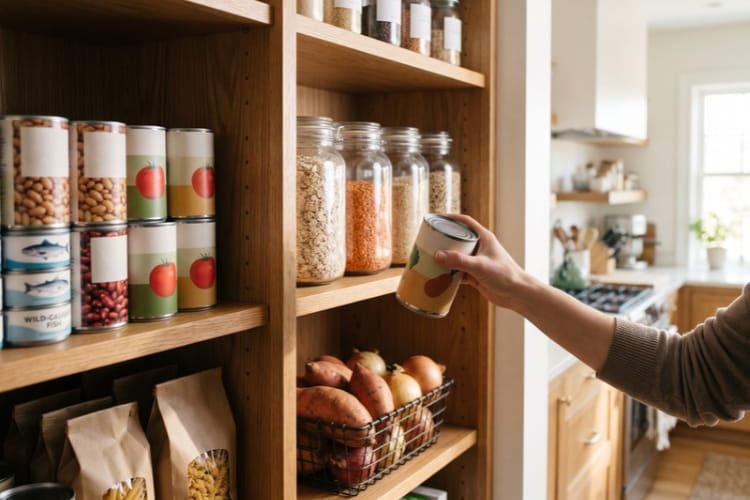
Shelf-Stable Family Pantry: Accessible Nutrition
Building a nutritionally resilient household does not require a specialty store. It is worth stating that plainly at the outset, because two quite different industries have a commercial interest in the opposite claim.
The first sells nutritional security as a premium category — organic, single-origin, adaptogenic, priced accordingly. The second sells it as insurance against extreme grid-down scenarios, in sealed buckets with twenty-five-year shelf lives and a price per calorie that bears no relation to the food inside. Both frame resilience as something a household acquires by spending, which conveniently locates the solution inside a transaction.
The useful version is less dramatic. A pantry (larder) is an active buffer-a low-cost reserve of ordinary food, bought at ordinary prices in ordinary shops, that absorbs the shocks a household actually experiences. Those are rarely catastrophic and frequently mundane: a supply chain disruption that empties a shelf for ten days, a winter storm that makes travel unwise, a fortnight of illness that removes the adult who shops, a month when money is tighter than expected. A buffer handles all four. A bucket of freeze-dried stroganoff handles none of them, because nobody opens it for a difficult fortnight.
The nutritional density framework
The standard critique of conventional emergency food storage nutrition is correct in its central point but overstated in its mechanism. Both parts are worth getting right.
The correct part: long-shelf-life food skews heavily toward refined carbohydrates and sodium because those are cheap to store. A reserve made mainly of white rice, instant noodles, crackers, and tinned soup supplies calories while providing very little else, and a household eating that way for two weeks will be adequately fed but poorly nourished.
What the evidence actually supports
It is frequently claimed that refined carbohydrates "spike stress hormones" during a crisis. That specific claim does not hold up well. A 2025 narrative review of food and nutrient effects on cortisol found that the association between a high-glycaemic diet and increased cortisol rests on a single study of twelve participants over three days, and describes the reactive-hypoglycemia-to-cortisol pathway as "a mechanistic proposal, not a tested finding." The same review reports weak evidence that high-protein diets may also raise cortisol, and concludes that the overall evidence is conflicting and should be treated as "translational hypotheses rather than evidence-based clinical guidance" (Paragliola et al., 2025).
The practical recommendation survives intact without that mechanism, because it rests on something better established. Protein, fat and fiber (fibre) slow gastric emptying and blunt the glucose excursion of a meal. The result is steadier energy and fewer irritability troughs between meals—which matters when the adults in a household need consistent judgment, and the children need not be falling apart at four in the afternoon. That is a sufficient argument. It does not need a cortisol claim propping it up, and it is more credible without one.
Protein and fats
Canned (tinned) fish is the highest-value item in this category: complete protein, long shelf life, no cooking required, and, in oily fish, omega-3 fatty acids. Mercury content varies considerably between species, which matters for children and in pregnancy, and is covered specifically below.
Legumes — tinned lentils, chickpeas, black beans, cannellini, butter beans — supply protein, fiber and minerals at a cost per gram of protein that nothing else in the shop approaches. Draining and rinsing tinned beans removes a substantial proportion of the added sodium, which addresses the main nutritional objection to them.
Nut and seed butters are calorie-dense, shelf-stable, require no preparation and are usually eaten willingly by children. Peanut butter is the cheapest; tahini and sunflower seed butter cover nut allergies.
Tinned or vacuum-packed cooked meats, long-life hard cheese and UHT milk extend the range where budget allows.
Complex carbohydrates and fiber
Rolled oats deserve particular attention, for a reason that becomes clear in the fuel section below: they are a whole grain that can be prepared with hot water rather than sustained boiling, or soaked cold overnight. Steel-cut oats are nutritionally similar and take considerably longer to cook, which makes them the better everyday choice and the worse blackout choice.
Brown rice, wholewheat pasta, quinoa, couscous and bulgur fill the rest of the category. Couscous and bulgur are worth noting because they rehydrate rather than boil.
Root vegetables-potatoes, sweet potatoes, onions, carrots, winter squash-keep for weeks without refrigeration in a cool, dark place and add texture and bulk that no tinned item matches.
Micronutrients
Tinned tomatoes are nutritionally excellent and logistically awkward, and the next section explains why. Lycopene is more bioavailable from processed tomatoes than from raw ones, so tinned is not a compromise here.
Dried herbs and spices carry essentially no nutritional weight per serving, and their value is entirely culinary — which is not a trivial function. The difference between a household eating lentils for the fourth consecutive day with resentment and one eating them with interest is usually cumin.
Tinned pumpkin, tinned or dried fruit without added sugar, and tinned vegetables fill remaining gaps. One honest limitation: vitamin C degrades substantially in storage and processing, so an extended period on a wholly shelf-stable diet is the one scenario where a standard multivitamin is a reasonable inclusion rather than a wellness purchase.
A note on framing. Turmeric, garlic, and similar items are often presented as anti-inflammatory agents. The evidence for meaningful clinical effect at culinary doses is thin, and this article does not make that claim. They belong in the pantry because they make food taste good, which is reason enough.
Canned fish and mercury: the one place to be precise
This is the section where general advice becomes genuinely unsafe if applied loosely, because "tinned fish" and "mackerel" are not single categories.
The FDA and EPA classify fish into three tiers for children and for those pregnant or breastfeeding (US Food and Drug Administration, 2024):
Three practical consequences:
"Mackerel" is not one thing. Atlantic and Pacific chub mackerel are among the lowest-mercury fish available. King mackerel is on the avoid list. Read the species on the tin, not the category on the shelf label.
Tuna is not one thing either. Canned light tuna (usually skipjack) is a Best Choice; albacore or "white" tuna is a Good Choice, which carries a lower recommended frequency.
"Wild-caught" is not the relevant variable. It is a marketing descriptor, and it does not track mercury content. The species does.
Recommended intake: children should have two servings per week from the Best Choices list. Those pregnant or breastfeeding should have two to three servings from Best Choices, or one from Good Choices. The serving size for an adult is 4 oz; for children, it scales by age-roughly 1 oz at ages 1–3, 2 oz at 4–7, 3 oz at 8–10, and 4 oz at 11.
Sardines, canned light tuna, and Atlantic mackerel together comfortably cover the protein requirement within those limits at low cost, which is why you should buy these specific ones rather than whatever is on offer.
Two approaches, compared
The decisive row is the second from the bottom. A stockpile is capital converted into food nobody intends to eat, and its deterioration is invisible until the day it matters. A buffer is food the household eats anyway, with the purchase brought forward. The second involves almost no financial risk, which is why it survives contact with a real budget.
Rotation and logistics
FIFO, but as two queues rather than one
First-In, First-Out means the oldest stock gets used first. Implemented simply as a pantry FIFO rotation system — new purchases to the back, cooking from the front — it prevents nearly all waste.
The refinement most guidance misses about canned-food shelf-life rotation is that a pantry doesn't have a single expiration date. USDA FSIS (and UK FSA guidelines on 'Best Before' dates) distinguish sharply between categories (US Department of Agriculture, Food Safety and Inspection Service, n.d.):
Low-acid tinned goods — meats, stews, beans, corn, potatoes: 2 to 5 years
High-acid tinned goods — tomatoes, fruit, juices, pickles: 12 to 18 months
Home-canned foods: 12 months
That is a three- to fourfold difference, and it falls on exactly the item most recommended for micronutrient density. Tinned tomatoes have the shortest shelf life of almost anything discussed here. The practical response is to run two queues: beans, fish and tinned meat on a slow rotation that largely looks after itself, and tomatoes, fruit and juices on a fast one that needs genuine attention.
Storage conditions matter and are easy to get wrong. FSIS advises keeping temperatures below 85°F (29°C), notes that temperatures above 100°F (38°C) are actively harmful, and specifically warns against storing tins above or beside a stove, under a sink, or in a damp garage or basement. The warm cupboard next to the oven is the worst location in most kitchens and a common choice.
The working buffer
The target is a two- to four-week rotating supply of family preparedness groceries the household already eats. Not special food. Not emergency food. More of the normal food.
The reasoning is partly practical and partly psychological. Practically, a buffer made of normal ingredients is consumed and replaced continuously, so nothing expires unnoticed and no money is tied up in stock that will be discarded. Psychologically, it means a disruption does not come with a change of diet attached. A child who is cold, bored, and off-routine has enough to contend with; being handed unfamiliar food by a visibly tense adult adds a variable at the worst moment.
Building it does not require a large shop. Buying one or two extra of items already on the list each week builds a four-week buffer in a couple of months, with no perceptible change in weekly spend.
Water and fuel: the constraint that reorders everything
Nutritional content is the wrong first filter for an extended outage. Preparation cost is.
Dried beans require soaking followed by one to two hours of sustained boiling. Brown rice needs roughly 45 minutes at a rolling boil and about two parts water to one part rice. In a functioning kitchen, these are trivial. Without mains power, they are expensive in two resources that are simultaneously finite: water and fuel.
A camping stove canister has a fixed burn time. Stored water does not replenish; it is heavy, and in a multi-story building it cannot practically be carried upward — the storage arithmetic and the weight involved are worked through separately in the weight has to go somewhere.
This produces a clear hierarchy for the outage subset of the pantry:
Needs nothing — tinned fish, tinned beans, nut butter, tinned fruit, tinned vegetables, long-life bread, crackers. Edible straight from the tin (tin), cold.
Needs hot water only, briefly — rolled oats, couscous, bulgur, instant noodles, powdered soup. A single kettle boil rather than sustained heat.
Needs sustained boiling — dried beans, brown rice, wholewheat pasta, steel-cut oats.
Dried pulses are excellent value and belong in a pantry. They are the wrong item to rely on during a power cut, and the solution is to keep both: dried for ordinary weeks, tinned for the subset of the buffer intended to work without power. A reasonable split is to keep roughly one week of the buffer in tiers one and two, entirely independent of cooking fuel.
Food safety: the short, non-negotiable part
A pantry article that omits this would be incomplete. USDA FSIS guidance on damaged tins is specific:
Discard any tin that is bulging, leaking, or swollen — swelling may indicate Clostridium botulinum or other spoilage organisms.
Discard a tin with a deep dent (one a finger can be pressed into) or a sharp dent on any seam. A shallow dent on an otherwise sound tin is considered safe.
Discard heavily rusted tins, since rust can perforate. Surface rust that rubs off is not serious; rust on the inside means the contents should not be eaten.
Do not taste food from a suspect container to check it. Never use food that smells foul, looks milky when it should be clear, or spurts liquid when opened.
Dispose of suspect tins double-bagged in sealed plastic, in non-recyclable waste outside the home.
Botulism is rare and serious; symptoms appear 12 to 48 hours after eating and include double vision, drooping eyelids, difficulty swallowing, and difficulty breathing. These symptoms warrant immediate emergency medical attention.
Home-canned low-acid foods should be boiled before serving — 10 minutes below 1,000 feet of altitude, plus one minute per additional 1,000 feet, and 20 minutes for spinach and corn at any altitude.
If there is an infant in the household
This falls outside the brief of a general pantry article and belongs in one anyway, because it is the single gap most likely to matter and the one most often omitted.
Powdered infant formula is not a sterile product. CDC and NHS emergency guidance advises that for higher-risk infants — under two months old, born prematurely, or immunocompromised — formula should be prepared with water at at least 158°F (70°C), by boiling and letting it cool for about five minutes, to reduce Cronobacter risk (Centers for Disease Control and Prevention, n.d.).
That requirement interacts badly with a power cut, because it needs boiling water on demand. Two consequences follow for a household with an infant: ready-to-feed liquid formula requires no water or heating, and holding some of it is worth the higher cost; the fuel budget for boiling water is no longer discretionary.
Prepared formula should be used within one hour of starting a feed and two hours of preparation, refrigerated immediately if not used, and used within 24 hours. Anything the baby does not finish is discarded, and formula of uncertain age is discarded.
Why an organized pantry settles the adults
The psychological effect of a stocked cupboard is not sentimental, and it has a mechanism worth naming.
The most cited synthesis of laboratory stress research found that a stressor's character matters more than its severity: uncontrollable situations produced substantially larger cortisol responses than controllable ones, with effect sizes of 0.52 versus 0.16, and the longest recovery times (Dickerson & Kemeny, 2004). Supply disruption is a textbook uncontrollable stressor — nobody in the household chose it, and nobody can say when it ends.
A pantry converts one component of that from uncontrollable to settled. The question of what the family eats this week has an answer, and someone calm at the time answered it weeks ago.
That matters beyond the adult's own comfort, because children calibrate threat to the adults around them rather than to events. A parent who is unhurried about food transmits information, and a household where mealtimes still look like mealtimes removes one of the several simultaneous changes that make disruption hard for children-a pattern worth understanding on its own terms in why children fall apart after the crisis ends.
There is a version of pantry-building that is anxious, acquisitive and faintly punitive, and it tends to produce food nobody wants to eat. The version described here is closer to administration: a known quantity of ordinary food, rotated, in a cool cupboard, costing almost nothing above the normal grocery bill.
What to do, in order
Audit what is already there. Most households have more shelf-stable food than they think, and some of it is past date. Start from the real position.
Write down five to seven meals the family actually eats that can be made from shelf-stable ingredients. This list, not a generic stockpile list, defines the pantry.
Work out the ingredients for two weeks of those meals. That is the initial target.
Buy toward it gradually — one or two extra items per weekly shop. No large purchase is needed, and none is advisable.
Separate the two rotation queues. Keep high-acid tins (tomatoes, fruit, juice) on a 12–18 month cycle, visible and used; keep low-acid tins on a 2–5 year cycle at the back.
Designate a no-cook subset. Roughly one week's worth that needs no fuel and no water: tinned fish, tinned beans, nut butter, tinned fruit, crackers.
Check the species on tinned fish. Sardines, Atlantic or Pacific chub mackerel, canned light tuna. Not King mackerel.
Fix the location. Cool, dry, dark, below 85°F (29°C). Not beside the oven, not under the sink, not in a damp basement.
If there is an infant, add ready-to-feed liquid formula and treat the water-boiling fuel budget as non-negotiable.
Add a multivitamin if an extended shelf-stable period is realistic, specifically to cover the vitamin C gap.
Cook from the front, shop to the back. This is the entire maintenance protocol.
The short version
Nutritional resilience requires a supermarket, not a specialty store. Both the wellness and the long-term-storage industries have an interest in the opposite claim.
The critique of conventional emergency food is right about refined carbohydrates and sodium but wrong about the mechanism—the “refined carbs spike stress hormones” claim rests on thin evidence, and the case for protein, fat, and fiber rests on glucose stability and satiety instead.
Tinned fish species matter: sardines, Atlantic and Pacific chub mackerel and canned light tuna are Best Choices; albacore is a Good Choice; King mackerel and bigeye tuna are on the FDA avoid list. "Wild-caught" is not the relevant variable.
Children: two servings per week from Best Choices, portioned by age (roughly 1 oz at 1–3, 4 oz at 11).
Shelf life is not one number. Low-acid tins last 2–5 years; high-acid tins — tomatoes, fruit, juices — last 12–18 months. Run two rotation queues.
Store below 85°F (29°C), dry and dark. Not next to the oven.
Target a two- to four-week rotating buffer of food the household already eats, built one or two items per shop.
Preparation cost reorders the priorities for an outage: dried beans and brown rice consume water and fuel that cannot be replaced. Keep about a week of the buffer edible cold.
Discard bulging, leaking, deeply dented, seam-dented, or heavily rusted tins. Never taste-test suspect food.
With an infant: higher-risk babies need formula made with water at 158°F (70°C); ready-to-feed liquid formula removes that dependency entirely.
An organized pantry converts an uncontrollable stressor into a settled question, which is most of its value.
True preparedness is not accumulation. It is the deliberate management of a small amount of ordinary food inside the real constraints of a household's budget, storage space, cooking fuel and water — and the payoff is that a difficult fortnight is experienced as a slightly dull one rather than as a crisis.
Continue reading
The wider framework — practical systems for urban preparedness, space-saving food security, and stress-free crisis management — is set out in our Grid-Down Apartment Survival Guide.
This article provides general information about food storage and household food planning. It is not individual dietary, medical, or nutritional advice, and it does not account for allergies, intolerances, medical conditions, medication interactions, pregnancy, or the needs of any specific child. Readers with particular dietary requirements, a diagnosed condition, or questions about feeding an infant should consult their GP, pediatrician, health visitor or a registered dietitian. If you suspect foodborne illness-especially if symptoms include double vision, drooping eyelids, or difficulty swallowing or breathing-contact your local emergency number immediately.
Disclosure: this article references a book written by the author of this site.